Feature importances and SHAP
AlloyGBM exposes SHAP-based explanation methods from the Python API, backed by a native Rust TreeSHAP implementation.
Local explanations
Use shap_values(...) to get per-row, per-feature attributions:
from alloygbm import GBMRegressor

model = GBMRegressor(deterministic=True, seed=7)
model.fit([[0.0], [1.0], [2.0], [3.0]], [0.0, 1.0, 2.0, 3.0])

values = model.shap_values([[1.5], [2.5]])
print(values)
To retrieve the expected value alongside the SHAP matrix:
expected_value, values = model.shap_values(
    [[1.5], [2.5]],
    include_expected_value=True,
)
Global importance
Use feature_importances(...) to aggregate SHAP importances across rows:
importance = model.feature_importances([[0.5], [1.5], [2.5]])
print(importance)
TreeSHAP implementation
AlloyGBM uses the polynomial-time TreeSHAP algorithm for computing exact Shapley values:
No practical limit on the number of features
Computation scales with tree complexity, not exponentially with feature count
Results are exact, not approximate
The previous brute-force method (limited to 25 features) has been replaced by
TreeSHAP in 0.2.0.
Current expectations
shap_values(...)returns one attribution per feature for each input rowfeature_importances(...)returns(feature_name, importance)tuplesFeature names are captured from training data when available, or default to generated names such as
f0andf1
Supported estimators
SHAP explanations work with all three estimators:
GBMRegressor.shap_values(...)GBMClassifier.shap_values(...)GBMRanker.shap_values(...)
Leaf model compatibility
leaf_model="constant" artifacts produce exact SHAP attributions
satisfying Σ shap_values + expected_value == predict(x).
As of v0.7.1, shap_values(...) and feature_importances(...) also
accept leaf_model="linear" (piecewise-linear) artifacts and return an
interventional decomposition: the path-based machinery attributes each
leaf’s “constant part” intercept + Σ wj · μj_global, and per-leaf row
deviations wj · (xj − μj_global) are credited directly to the regressor
features along the row’s path. Global per-feature means μj_global are
captured at fit time and stored in the artifact, so SHAP is self-contained
— the original training data is not required at explain time.
As of v0.7.4, strict additivity
(Σ shap_values + expected_value == predict(x) within
atol + rtol·|predict(x)|, default 1e-5 + 1e-4·|predict(x)|) also
holds for leaf_model="linear" artifacts on the default
predictor-aligned binning path. v0.7.3’s BinningContext aligns the
SHAP path walker to the predictor’s float thresholds; v0.7.4 credits
Σⱼ wⱼ·(xⱼ − μⱼ) at every visited node along the row’s path (matching
how predict accumulates leaf.eval_row(row) at each visited node).
The legacy non-binning SHAP path retains a best-effort exemption for
linear leaves only.
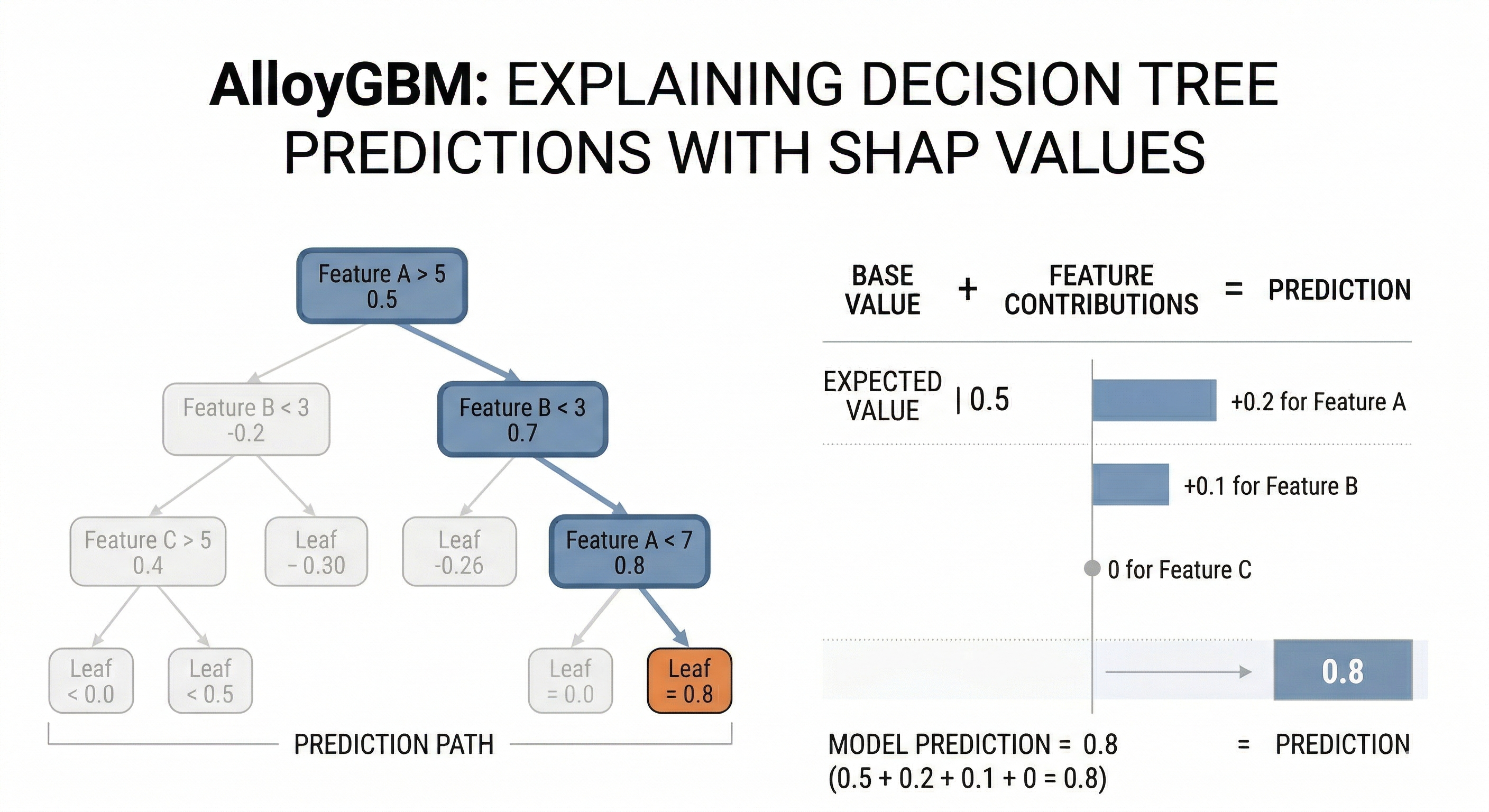
Example of a prediction path and additive SHAP-style contribution breakdown.
SHAP interaction values (v0.11.0+)
GBMRegressor.shap_interaction_values(X) returns pairwise SHAP
attributions as an (n_rows, n_features, n_features) tensor.
Implements Lundberg et al. (2020) “From local explanations to global
understanding with explainable AI for trees” Algorithm 2 in polynomial
time O(T · L · D² · M) where M is the feature count.
Invariants (within atol = 1e-5 + rtol = 1e-4 · |predict(x)|):
Symmetric:
values[r][i][j] == values[r][j][i].Row-marginal:
Σ_j values[r][i][j] == shap_values(X)[r][i].Full additivity:
Σ_i Σ_j values[r][i][j] + expected_value
== predict(x)
.
The diagonal values[r][i][i] is the “main effect” of feature i
after subtracting all off-diagonal interactions. Pass
include_expected_value=True to receive a (expected_value,
interactions) tuple.
Scope limits:
leaf_model="linear"artifacts are supported. The row-dependent linear deviation terms are attributed directly to the main effect (the diagonal of the interaction matrix) to preserve both row-marginal and full additivity invariants.GBMClassifier.shap_values(X)andGBMClassifier.shap_interaction_values(X)return a list ofKarrays — one per class logit (v0.12.6+).MultiLabelGBMRanker.shap_values(X)andMultiLabelGBMRanker.shap_interaction_values(X)return a list ofn_labelsarrays — one per output (v0.12.6+). Joint mode routes through per-output Rust entry points; independent mode fans out to per-labelGBMRankercalls.